
The December Systems Sprint: Building Habits and Workflows That Run on Autopilot by 2026
Most leaders treat December as a runway for resolutions. Then January hits, the calendar fills, and those resolutions are the first thing to go.
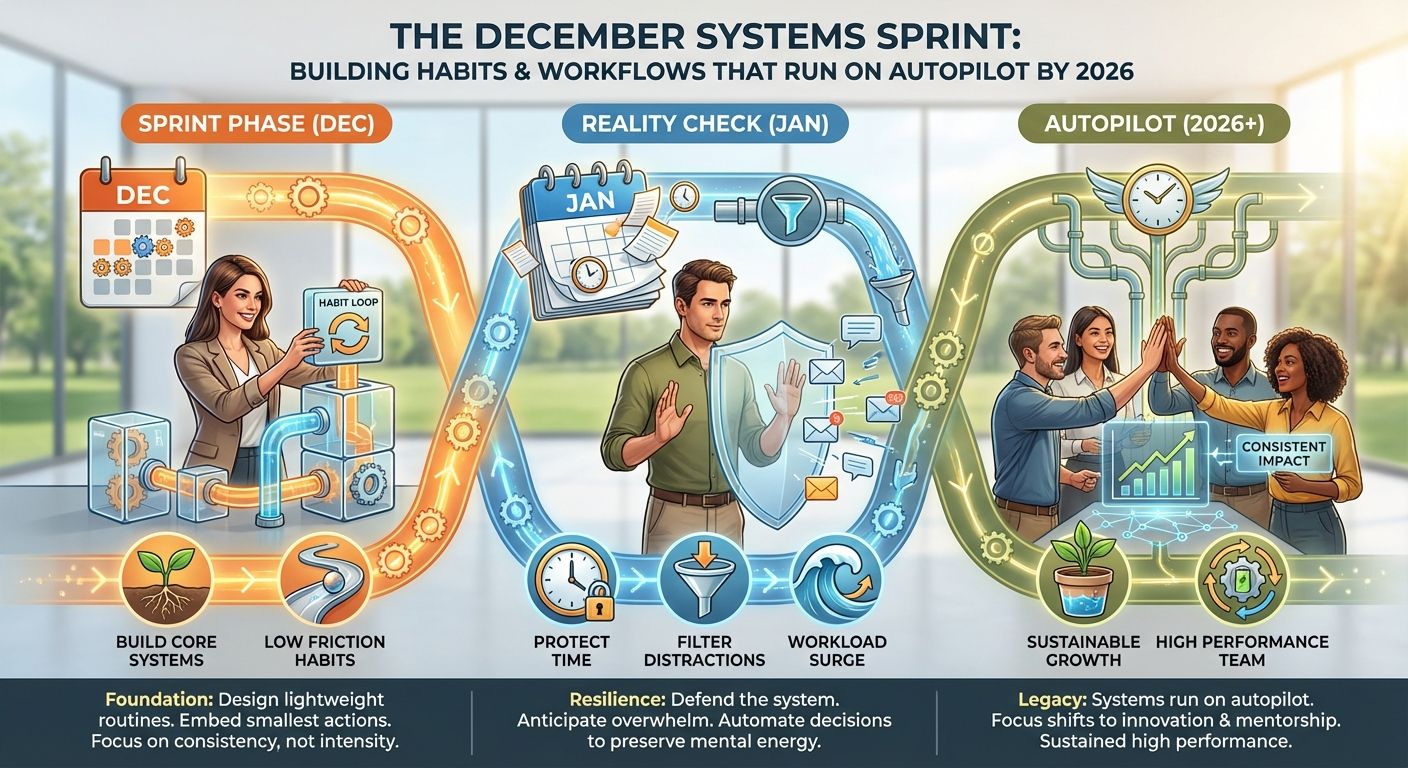
Most leaders treat December as a runway for resolutions. Then January hits, the calendar fills, and those resolutions are the first thing to go.
Instead of asking people to “be more motivated” in 2025, you can give them something far more reliable: systems that quietly run in the background—protecting wellbeing, enabling focus, and supporting sustainable performance all the way into 2026.
This is where December becomes strategic: not for setting goals, but for designing and stress‑testing systems.
Why systems beat resolutions (for people and performance)
Resolutions rely on willpower. Systems make the right behavior the default.
- Gallup consistently finds that employees who strongly agree their employer cares about their wellbeing are three times more likely to be engaged and 69% less likely to search for a new job. That’s a retention and performance strategy, not a wellness “perk.” (Gallup)
- Yet Deloitte reports that nearly 50% of employees are experiencing burnout, while leaders underestimate its prevalence. (Deloitte)
What bridges this gap? Not one-off campaigns, but embedded routines: how we plan our weeks, track workloads, recover, and communicate.
December is uniquely suited for this work:
- Workloads often dip just enough to allow reflection.
- Next-year planning is underway, so process changes are top of mind.
- People are already thinking about “next year”—you can redirect that impulse from vague resolutions to concrete workflows.
The goal: by January, your people don’t need new promises. They have minimum viable systems already running.
Step 1: Choose one system per key life and work area
For your workforce, complexity kills follow-through. Start by piloting one simple system in each of four core areas that directly affect performance and retention:
- Money & financial stress
- Physical health & energy
- Deep work & focus
- Digital organization & overload
Harvard Business Review notes that financial stress can consume hours of cognitive bandwidth each week, directly reducing productivity and decision quality. (Harvard Business Review) Similarly, McKinsey estimates that knowledge workers spend up to 20–30% of their time just searching for information. (McKinsey) These are solvable with thoughtful systems.
Your December sprint is not to “fix everything.” It’s to pilot one repeatable workflow per area that can scale in 2025 and still be working quietly in 2026.
Step 2: Design “minimum viable habits,” not ideal routines
Think like a product leader, not a motivational speaker. In December, you’re building minimum viable habits (MVHs)—the simplest, smallest version of a system that still delivers value.
1. Money tracking: A 10-minute weekly review
MVH: One 10-minute “money check-in” per week.
- Auto-categorise expenses in a basic tool or bank app.
- Answer three questions:
- What surprised me?
- What can I stop or downgrade?
- What do I want to protect next month?
For employees, financial stability is directly tied to stress levels, which in turn affect absenteeism and performance. Gallup links high financial wellbeing to lower daily stress and higher engagement. (Gallup) Even a basic review practice can start to reduce uncertainty and anxiety.
For organizations:
Pilot this as an opt-in micro-learning or facilitated session. Make it normal and shame-free, not remedial.
2. Exercise & recovery: A “non-zero” movement rule
MVH: A “non-zero day” rule for movement: 5 minutes counts.
- Encourage employees to pick one default: a 10-minute walk, a brief stretch block, or a basic routine.
- The goal is repetition, not intensity.
Research highlighted in Business Insider shows that even very short bouts of movement, repeated consistently, improve mood and cognitive function across the day. (Business Insider) What matters is embedding the identity of “I move every day,” not hitting a perfect workout schedule.
For organizations:
Protect small windows in the calendar culture—e.g., “no-meeting 15s” twice a week—and normalize using them for movement.
3. Deep work: One daily focus block
MVH: One protected 45–60 minute focus block per workday.
- Same time each day where possible.
- One task only; all notifications off; calendar protected.
- Team norms: no non-urgent messages or meetings during that block.
Gallup data shows that employees who can do what they do best every day are significantly more engaged and less likely to experience burnout. (Gallup) Deep work blocks create the environment where “doing my best work” is actually possible.
For organizations:
Pilot focus blocks with a single team in December. Measure simple outcomes:
- Perceived focus (pulse survey)
- Self-rated productivity
- Impact on meeting load
Use what you learn to scale in Q1.
4. Digital organization: A weekly “systems reset”
MVH: One 30-minute “digital reset” each week.
- Empty inbox to a simple triage: do, delegate, defer, delete.
- Archive or close stale projects in tools.
- Review upcoming week: key deliverables, risks, and recovery time.
Knowledge workers regularly lose hours to context switching and digital clutter. McKinsey notes that poor information management is a major hidden cost in organizations. (McKinsey) A reset ritual reduces friction and mental load.
For organizations:
Model this at leadership level. When executives protect their own reset time—and don’t send late-night emails—it gives permission for healthy boundaries.
Step 3: Stress-test the systems in December conditions
December is messy: year-end deadlines, holidays, travel, family demands. That’s precisely why it’s the perfect test environment.
Ask three questions of each pilot system:
- Does it work on a bad week?
If people can’t maintain it during crunch time, it’s too fragile. - Can it survive low motivation?
MVHs should require almost no willpower—just triggering and doing. - Is it kind to real humans?
If a habit fails once, can it be resumed easily without guilt or backlog?
Gather fast feedback from a small sample—pulse surveys, quick check-ins, anonymous comments. Deloitte’s research on human sustainability highlights that interventions work best when they are designed with employees, not for them. (Deloitte)
Your outcome by January: systems that have already survived real-life conditions, not untested resolutions.
Step 4: Turn habits into templates and checklists
To make these systems scale into 2026, capture them as assets, not just ideas in people’s heads:
- Templates:
- Weekly financial check-in prompts
- “Non-zero day” movement menu
- Deep work calendar blocks with descriptions
- Weekly digital reset checklist
- Checklists:
- “How to run a focus-friendly team week”
- “End-of-week reset” operational steps
Share them in the tools your people already use—Slack/Teams, HRIS, or wellbeing platforms—so they’re discoverable and easy to adopt.
This is where platforms like October Health can help: embedding these check-ins, nudges, and routines into a structured, measurable wellbeing program rather than leaving them as good intentions in a slide deck.
Your December action plan—and how October Health can help
For the rest of this month, you can:
- Pick one team or business unit as your December systems sprint pilot.
- Choose one minimum viable system in each area: money, movement, focus, and digital reset.
- Run them for three weeks, gathering light-touch data on stress, focus, and perceived support.
- Turn what works into templates, norms, and rituals you can roll out wider in Q1.
October Health partners with organizations to do exactly this:
- Translate wellbeing aspirations into concrete, trackable routines.
- Embed them in everyday workflows, not just campaigns.
- Use data to show their impact on engagement, absenteeism, and retention.
If you want 2026 to be the year your organization benefits from healthier, more focused, more resilient people, December is your systems sprint window.
Start small. Design for real life. And let October Health help you turn human-centered systems into measurable business outcomes that last.
Make the next decision clearer.
Tell us what your team needs. We’ll walk you through the relevant features, support options and how to get started.