
Human-First by Design: Principles for Implementing AI in HR Without Losing the Human Touch
AI is already in your workplace—whether you’ve sanctioned it or not. The question for HR leaders isn’t if you’ll use AI, but how you’ll do it without eroding the trust, empathy, and psychological safety your people need to thrive.
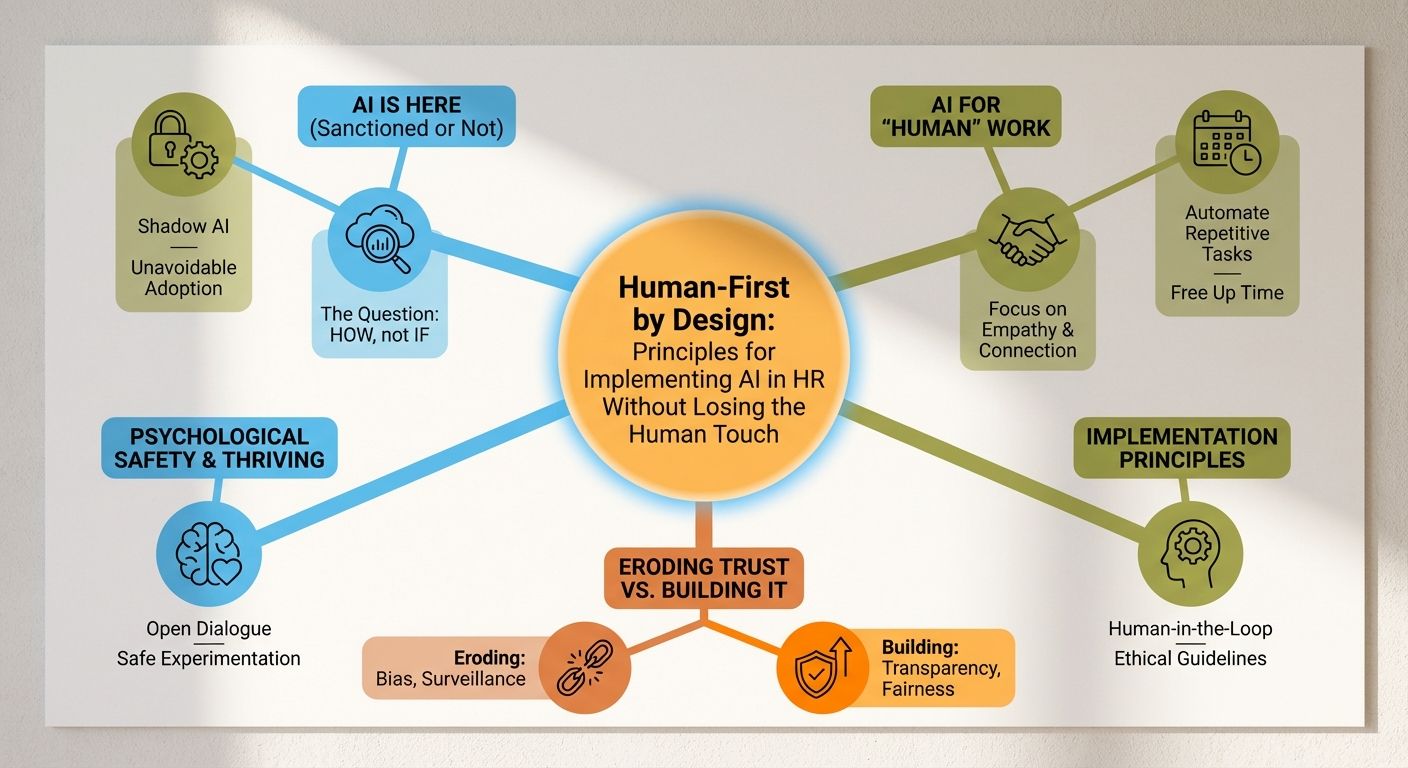
AI is already in your workplace—whether you’ve sanctioned it or not. The question for HR leaders isn’t if you’ll use AI, but how you’ll do it without eroding the trust, empathy, and psychological safety your people need to thrive.
When designed well, AI doesn’t replace the “human” in human resources. It protects it—by freeing HR from low‑value admin so they can spend more time listening, coaching, and supporting people.
This is where a human‑first, AI‑enabled approach becomes essential.
Why HR Can’t Afford to Get AI Wrong
Employees are paying attention to how you use technology:
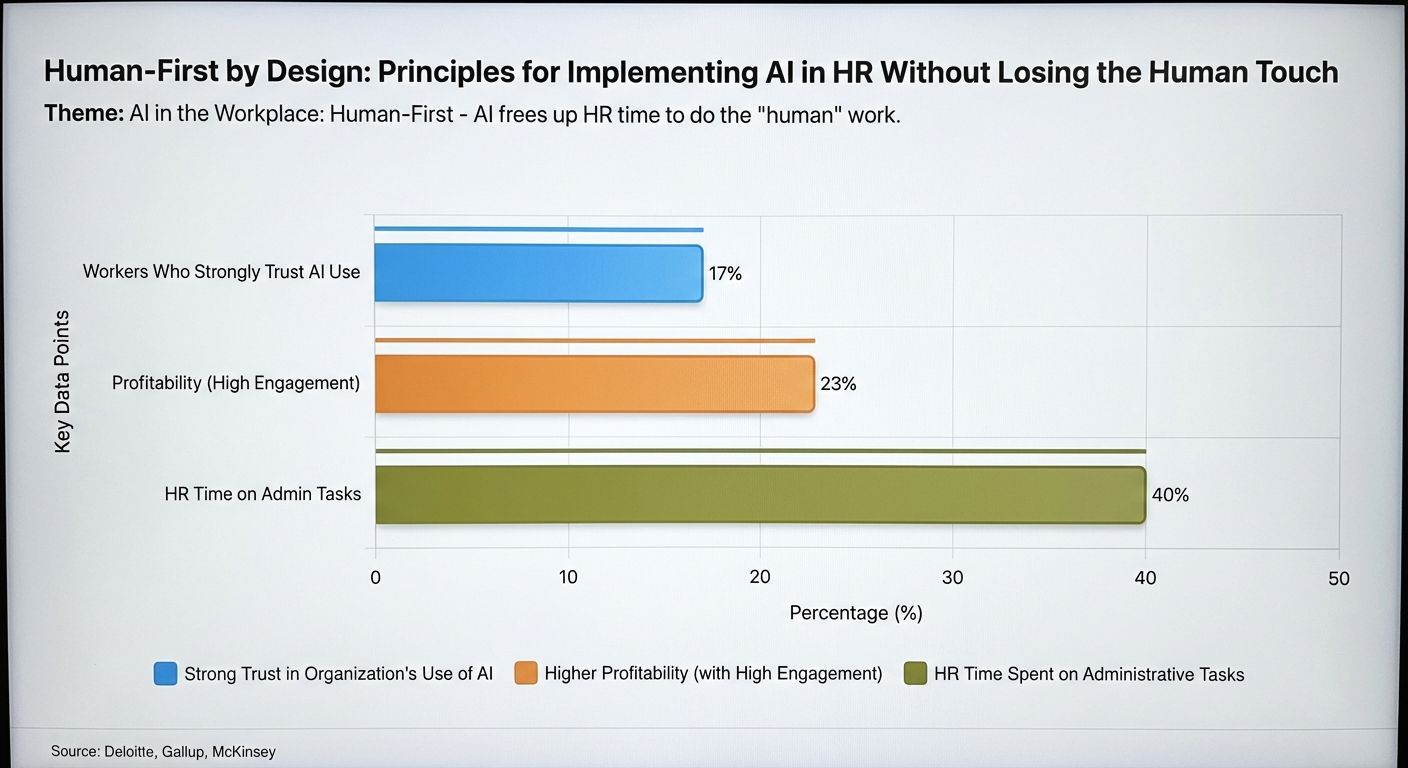
- Deloitte found that only 17% of workers strongly trust their organization’s use of AI, yet trust is a key driver of engagement and retention.
- Gallup reports that teams with high engagement see 23% higher profitability and up to 43% lower turnover, but engagement drops when people feel surveilled or dehumanized.
At the same time, HR workloads are unsustainable. HR professionals often spend up to 40% of their time on administrative tasks (McKinsey), time that could be spent on coaching managers, addressing burnout, or designing better employee experiences.
AI can be the bridge—if you design it with people, not just efficiency, in mind.
A Human‑First Framework for AI in HR
Below is a practical framework to guide AI adoption in HR, grounded in five principles:
- Transparency
- Consent
- Augmentation, Not Replacement
- Fairness
- Accountability
Use these to assess any AI tool—from interview assistants to performance analytics to engagement platforms.
Principle 1: Transparency — “Nothing About You, Without You”
Employees should never wonder if they’re being evaluated or analyzed by AI.
Guiding questions
- Do employees clearly know where and how AI is used in HR?
- Can they access explanations of what data is collected and why?
- Can they ask questions or challenge the use of AI?
Sample policy language
“We use AI to assist with scheduling, basic candidate screening, and identifying engagement trends. AI tools do not make final decisions about hiring, promotion, or termination. You can request more information on any AI-assisted process at any time.”
Checklist for HR
- Publish an AI in People Practices overview on your intranet.
- Communicate changes in plain language—not legal jargon.
- Include AI usage and limits in privacy notices, offer letters, and policy handbooks.
Principle 2: Consent — Give Employees Real Choices
Trust grows when employees feel they have agency.
Guiding questions
- Where can we offer opt‑in or opt‑out choices?
- Are we collecting only the data we truly need?
- Do we explain the benefit to the employee, not just the business?
Example: AI‑powered engagement surveys
Instead of:
“We now use AI to analyze your survey responses.”
Try:
“We use AI to identify themes and risk areas from anonymized survey data. This allows us to respond faster to wellbeing and workload pressures across teams. You can choose not to participate in any survey.”
Consent practices
- Use clear consent prompts for any new AI‑driven initiative.
- Offer alternative channels (e.g., human‑led feedback sessions).
- Make withdrawal of consent simple and without penalty.
Principle 3: Augmentation, Not Replacement
AI should make HR more human, not less.
According to McKinsey, up to 56% of typical HR tasks can be automated or augmented by existing technology—but the highest impact comes when HR uses this freed capacity to focus on coaching, listening, and strategy, not just cost cutting.
Good use cases
- AI interview assistants that generate structured questions, while humans handle rapport, nuance, and final decisions.
- Performance analytics that surface patterns (e.g., workload vs. burnout risk), while managers handle context, empathy, and development.
- Wellbeing platforms that personalize resources, while human professionals handle complex or high‑risk issues.
Red flags
- AI making final decisions on hiring, firing, or promotions.
- Replacing 1:1 conversations with bots in moments of crisis.
- Using AI solely to drive efficiency, without parallel investment in manager capability and employee support.
Augmentation checklist
- For every AI tool, define: What becomes more human as a result?
- Set explicit boundaries: what AI will not be used for.
- Track whether HR time is actually shifting toward strategic, people‑centric work.
Principle 4: Fairness — Design for Equity From Day One
Bias and inequity are already present in many HR processes. AI can either amplify or mitigate them.
Harvard Business Review notes that AI can reduce certain forms of bias—for example, by standardizing interview questions—but only when models are trained and monitored carefully over time.
Practical safeguards
- Insist on bias testing from vendors across gender, race, age, and other protected attributes.
- Regularly review AI‑informed decisions (shortlists, ratings, recommendations) for unintended disparities.
- Involve diverse employees in reviewing AI use cases and language.
Fairness checklist
- Require vendors to share methodology for bias detection and mitigation.
- Conduct quarterly fairness audits on AI‑supported decisions.
- Pair AI insights with human review for edge cases and critical decisions.
Principle 5: Accountability — Humans Stay on the Hook
No HR leader should ever say, “The system decided.”
Gallup emphasizes that manager behavior and organizational culture remain the strongest predictors of engagement and retention, far outweighing tools alone. Technology can inform decisions, but leaders remain accountable for outcomes.
Accountability practices
- Assign clear AI owners in HR (e.g., a People Analytics or People Ops leader).
- Establish an AI Oversight Group that includes HR, Legal, IT, and employee representatives.
- Create a simple issue‑reporting channel for employees to flag concerns about AI‑driven processes.
Sample accountability statement
“AI is one input into our HR decision-making, not the decision-maker. Leaders are accountable for understanding AI‑generated insights, applying human judgment, and ensuring fair, ethical outcomes.”
How This Looks in Practice
AI interview assistant
- Uses structured criteria to support consistency and reduce halo effects.
- HR publishes a one‑page explainer for candidates about how interviews are supported by AI.
- Final hiring decisions are made by human panels, with AI used only for note‑taking and scoring guidance.
Performance and wellbeing analytics
- Aggregate data identifies teams at risk of burnout based on workload, engagement, and sentiment trends.
- HR partners with October Health and managers to offer targeted support—such as group sessions, manager coaching, and mental health resources—rather than surveillance.
- Employees see how their feedback translates into concrete changes, reinforcing trust.
Bringing It All Together: Human‑First by Design
AI can help HR move from firefighting to foresight—from form‑filling to real conversations. But that only happens when you:
- Make AI use transparent and consensual
- Focus on augmentation, not automation of empathy
- Build fairness and accountability into every tool and workflow
At October Health, we help organizations apply these principles specifically to mental health, engagement, and retention—using AI to spot risk earlier, personalize support, and free your HR and managers to do the work only humans can do.
If you’re ready to design a human‑first, AI‑enabled people strategy—and to turn wellbeing into a measurable business advantage—explore how October Health can partner with you to:
- Detect burnout and disengagement earlier
- Offer scalable, evidence‑based mental health support
- Improve manager effectiveness and team resilience
- Drive measurable improvements in retention and performance
Let’s build an AI future where your people feel more seen, not more scanned.
Make the next decision clearer.
Tell us what your team needs. We’ll walk you through the relevant features, support options and how to get started.