
The Hidden Price Tag of Regrettable Resignations: Beyond Recruitment and Replacement
Losing a high performer doesn’t just hurt—it compounds. You feel it in missed targets, strained teams, confused customers, and a leadership calendar that suddenly fills with “urgent” backfills instead of strategic work.

The Hidden Price Tag of Regrettable Resignations: Beyond Recruitment and Replacement
Losing a high performer doesn’t just hurt—it compounds. You feel it in missed targets, strained teams, confused customers, and a leadership calendar that suddenly fills with “urgent” backfills instead of strategic work.
Most organizations still treat regrettable resignations as an unavoidable cost of doing business. But when you look closely, the real price tag is far higher—and far more controllable—than most leaders realize.
What Is a “Regrettable Resignation,” Really?
A regrettable resignation isn’t just any departure; it’s when someone leaves whose loss materially harms your business:
- Top 10–20% performers
- Critical role holders (customer relationships, technical expertise, institutional memory)
- Culture carriers others look to for cues and stability
Gallup estimates that replacing an employee can cost from one-half to two times their annual salary when you factor in recruiting, onboarding, and ramp time. For high performers and critical roles, the real cost is often on the high end—or higher—because you’re not just replacing a person; you’re rebuilding a capability. (Source: Gallup)
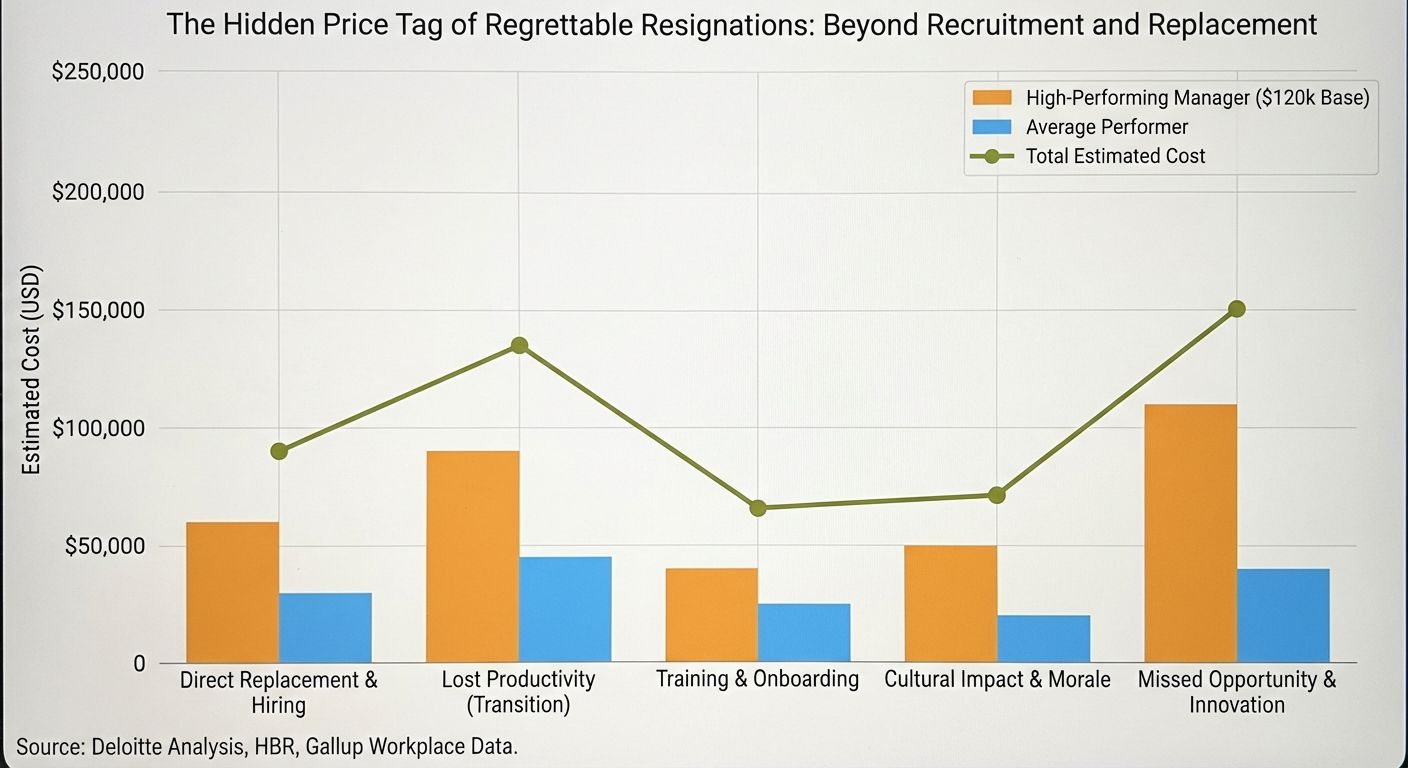
A Simple Model: What One Regrettable Resignation Really Costs
Let’s take a high-performing manager earning $120,000 base salary in a revenue-impacting function (sales, product, customer success, operations).
Below is a conservative, simplified view of the total cost of losing them.
1. Direct Replacement & Hiring Costs
- Recruiter fees / internal TA cost: ~$15,000–$25,000
- Job ads, tools, assessments, background checks: ~$3,000–$5,000
- Hiring manager + panel time (10–15 hours of senior time at blended $150/hour): ~$1,500–$2,250
Range: ~$20,000–$30,000
These are the costs most companies recognize. They’re also the smallest part of the real impact.
The Hidden Costs Most Leaders Underestimate
2. Lost Productivity During Transition and Ramp
The productivity gap starts before they walk out the door and continues long after.
Notice period:
In the final 4–8 weeks, even a committed high performer is often operating at 60–80% productivity due to transition work, knowledge transfer, and emotional disengagement.
- Assume 2 months at 70% output → 30% loss for 2 months
- On a $120k salary (~$10k/month), that’s $6,000 in productivity lost pre-exit.
Ramp time for replacement:
Research from the Corporate Executive Board (CEB) has shown that complex roles often take 6–9 months to reach full productivity. New hires don’t just learn tasks; they learn context, relationships, and your organization’s unwritten rules.
If your new hire averages 60–80% productivity for 6 months:
- Assume 70% productivity over 6 months → 30% gap for 6 months
- 6 months × $10k/month × 30% = $18,000 in lost productivity
Conservative total productivity cost:
≈ $24,000 (pre-exit + ramp)
3. Institutional Knowledge and Relationship Drain
When a high performer leaves, they take with them:
- Historical context on why certain decisions were made
- Workarounds that keep operations running
- Deep familiarity with systems and customers
- Social capital and trust across the organization
Deloitte has highlighted that knowledge loss is one of the most underestimated risks in talent management, particularly for experienced and high-impact roles. (Source: Deloitte)
This shows up as:
- Rework: Projects stall or are redone because context is missing
- Slower decision-making: New owners revisit old questions, delaying execution
- Increased errors: Small mistakes creep in as teams “figure it out”
For our single regrettable resignation, even a 5–10% efficiency loss across a small team of 5–7 people for three months can easily equal another $10,000–$20,000 in hidden cost.
4. Culture and Morale: The Ripple Effect Across the Team
People don’t evaluate their work experience in a vacuum—they watch what happens to others like them.
Gallup consistently finds that actively disengaged employees cost organizations 18% of their annual salary in lost productivity through absenteeism, turnover, and lower output. (Source: Gallup)
What often follows a regrettable resignation:
- Remaining team members question: “Am I next?”
- Engagement dips as people worry about workload and fairness
- Informal leaders—those who set the tone—are gone
Imagine a team of 6 where engagement drops for just three remaining high performers:
- Each at $120,000 salary
- 10% productivity loss for 3 months
- 3 employees × $10k/month × 3 months × 10% ≈ $9,000
And that’s before you account for potential secondary resignations. Research from Work Institute has shown that up to 77% of turnover could be prevented with proactive intervention and support. (Source: Work Institute)
5. Customer Churn and Brand Damage
In many companies, top performers sit at the center of critical customer relationships.
Consider just one scenario:
- Departing manager owns relationships with accounts generating $2M in annual revenue
- Their departure causes confusion, minor service lapses, or missed renewal signals
- Even a small 2–3% churn attributable to that gap is $40,000–$60,000 in lost revenue
McKinsey has noted that organizations with healthy, engaged cultures significantly outperform peers in customer satisfaction and retention. (Source: McKinsey) In real terms, that means regrettable resignations are not just “people issues”—they’re customer issues.
6. Leadership Distraction and Strategic Opportunity Cost
Every hour senior leaders spend:
- Rewriting job descriptions
- Debating comp bands
- Interviewing replacements
- Calming anxious teams
…is an hour not spent on strategy, innovation, or growth.
If a VP and senior leaders collectively spend 40–60 hours on the backfill and fallout, at a conservative blended rate of $200/hour, that’s another $8,000–$12,000 in opportunity cost.
Adding It Up: One Resignation, Six-Figure Impact
Let’s revisit our conservative estimates for a single regrettable resignation:
- Direct hiring and replacement: $20,000–$30,000
- Productivity loss (exit + ramp): ~$24,000
- Knowledge and relationship drain: $10,000–$20,000
- Morale and culture impact: ~$9,000
- Customer churn risk: $40,000–$60,000
- Leadership distraction: $8,000–$12,000
Total conservative impact:
≈ $111,000–$155,000 for one regrettable resignation.
Scale that across 10–20 regrettable resignations in a year, and you’re quietly eroding millions in value—often without a single line item in the budget to show for it.
Turning the Cost of Regrettable Resignations Into a Business Case for Prevention
The good news: much of this is predictable and preventable.
Leaders who reduce regrettable resignations don’t just offer perks; they build systems that:
- Detect early signs of burnout, distress, and disengagement
- Provide timely, confidential mental health and wellbeing support
- Equip managers to have better 1:1s, hard conversations, and follow-through
- Normalize help-seeking and psychological safety at scale
Deloitte has reported that every dollar invested in workplace mental health yields a positive ROI when programs are well-designed, accessible, and embedded in daily work. (Source: Deloitte) In other words, proactive support is not a benefit line item; it’s a retention and performance strategy.
How October Health Helps You Reduce Regrettable Resignations
At October Health, we focus on measurable employee wellbeing and retention outcomes—not just participation rates or feel-good initiatives.
We help organizations:
- Identify at-risk groups earlier through anonymized, real-time engagement and distress signals
- Provide immediate access to human-guided digital support, group sessions, and specialist care
- Equip managers with tools and insights to support their teams before disengagement turns into a resignation letter
- Track impact in hard metrics: reduced absenteeism, improved engagement, and lower regrettable turnover
If even a small reduction in regrettable resignations can unlock six or seven figures in preserved value, the question shifts from “Can we afford this?” to “Can we afford not to?”
If you’re ready to turn the hidden cost of regrettable resignations into a clear, positive ROI on wellbeing and retention, October Health can help you design a data-informed, people-first approach.
Let’s protect your people—and the value they create—before the next resignation becomes another avoidable loss.
Make the next decision clearer.
Tell us what your team needs. We’ll walk you through the relevant features, support options and how to get started.