
AI as Your HR Copilot: Real Use Cases Where Automation Creates More Space for Empathy
AI is often sold as a way to “do more with less.” In HR, the real opportunity is different...
AI is often sold as a way to “do more with less.” In HR, the real opportunity is different: do less admin, more human. When automation takes on routine work, HR leaders can focus on what only humans can do—listening, coaching, and building cultures where people can thrive.
This is not theory. Organizations are already using AI to reclaim HR capacity and turn it into deeper, more human-centered support.
From Ticket Triage to Real Conversations
Most HR teams are buried under repetitive questions: leave policies, benefits rules, payroll timelines, and more. It’s work that’s essential—but not necessarily human.
Scenario 1: An AI HR FAQ Copilot
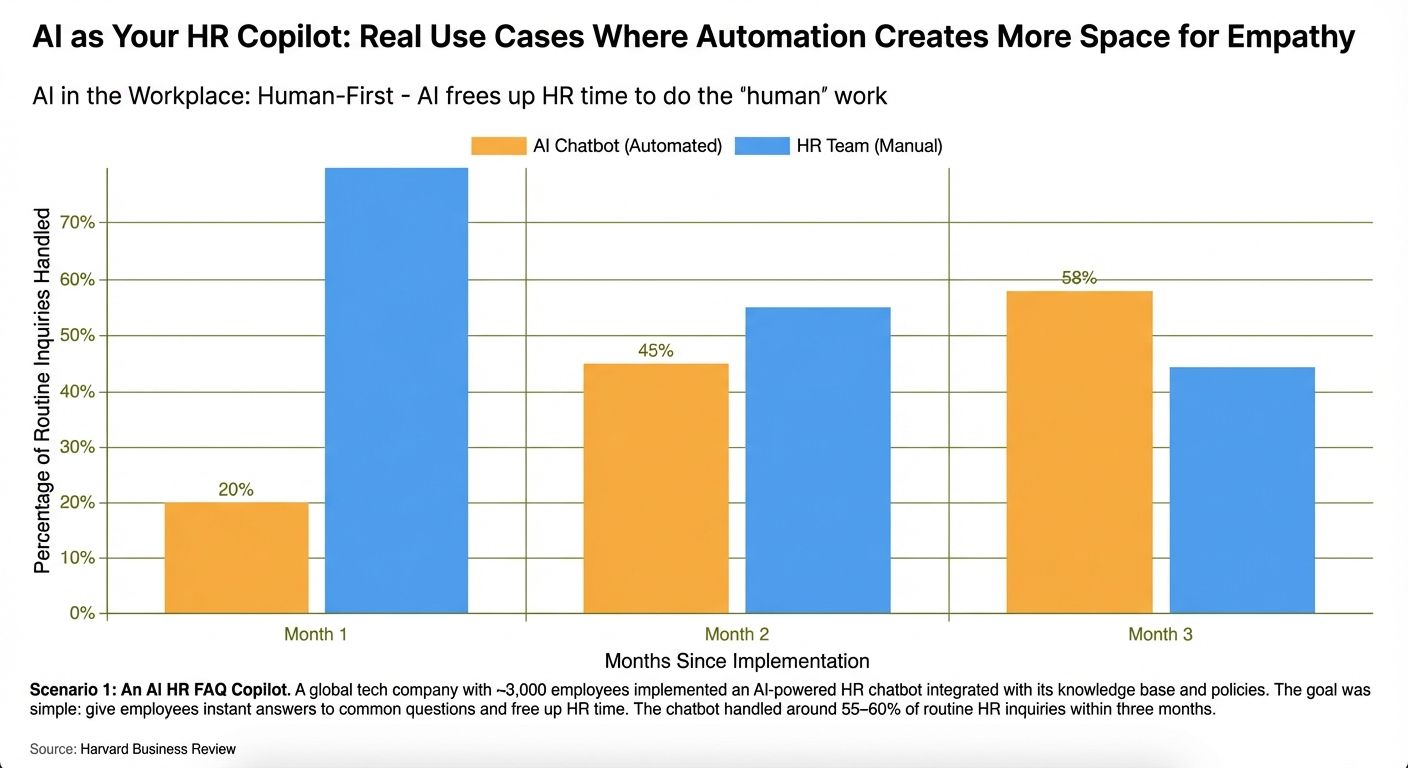
A global tech company with ~3,000 employees implemented an AI-powered HR chatbot integrated with its knowledge base and policies. The goal was simple: give employees instant answers to common questions and free up HR time.
What changed:
- The chatbot handled around 55–60% of routine HR inquiries within three months.
- Median HR response time for remaining tickets dropped from 2.5 days to under 24 hours.
- HR business partners reported gaining back 4–6 hours per week, which they redirected to manager coaching and complex employee situations.
This shift aligns with broader patterns. Deloitte has found that high-performing HR organizations are over twice as likely to use AI or automation for employee service delivery, freeing capacity for strategic work.1
The human impact:
Instead of spending mornings sorting through inboxes, HR partners now:
- Join skip-level meetings to understand team dynamics.
- Run office hours for managers dealing with performance or conflict.
- Offer individual support for employees navigating health, family, or workload challenges.
The chatbot didn’t reduce the need for HR—it surfaced where HR’s human presence mattered most.
Automating Onboarding, Not the Welcome
Onboarding is one of the most emotionally charged moments in the employee journey. Done well, it builds trust and commitment; done poorly, it creates churn risk from day one.
Yet much of onboarding is logistics: forms, access, policies, reminders.
Scenario 2: Automated Workflows, Human-Led Welcome
A fast-growing healthcare company hiring 80–100 people per quarter used AI to automate its onboarding workflows:
- Offer letters, background checks, and paperwork sequencing.
- IT and systems access triggered automatically based on role.
- Personalized checklists for managers and new hires.
The automation cut manual onboarding administration time by roughly 40%, according to their internal tracking. This is consistent with McKinsey research estimating that up to 56% of typical HR tasks are automatable with current technologies.2
What HR did with the time:
- Designed a “first 30 days” coaching program for managers.
- Scheduled 1:1 welcome conversations between HR and each new hire focused on expectations, wellbeing, and support.
- Introduced group onboarding circles where new hires share experiences and build peer support.
Outcomes over two quarters:
- Time-to-productivity (as measured by manager ratings) improved by ~20%.
- Early attrition (within six months) dropped by 15%.
- New-hire engagement scores at 90 days rose significantly, mirroring Gallup findings that structured onboarding improves engagement and retention.3
AI didn’t replace the welcome—it protected it. The paperwork still got done. But HR and managers finally had the space to focus on relationships, not reminders.
Seeing Burnout Before It Becomes Turnover
Many organizations only recognize burnout when people quit, go on extended leave, or disengage. By then, the damage—to individuals and to the business—is significant.
Gallup has reported that burned-out employees are 2.6 times more likely to be actively seeking a new job and far more likely to report frequent health issues.4 The cost is real, but often invisible until it’s too late.
Scenario 3: Predictive Analytics for Proactive Care
A regional financial services firm combined AI-driven analytics with existing employee data—engagement surveys, workload indicators, overtime patterns, and October Health utilization data (de-identified and aggregated). They were not scoring individual people for “risk,” but rather identifying hotspots and patterns.
The system flagged:
- Teams with consistently high after-hours activity.
- Functions where engagement scores and psychological safety indicators were trending down.
- Manager groups with elevated reported stress in mental health check-ins.
HR’s human response:
- Confidential outreach to managers to understand context and stressors.
- Targeted wellbeing support for affected teams: mental health group sessions, lighter sprint cycles, and focused leadership coaching.
- Clear messaging to employees normalizing help-seeking and reinforcing psychological safety.
Within six months:
- Self-reported burnout in affected teams, measured via pulse surveys, dropped by ~18%.
- October Health session usage increased in those groups, indicating higher willingness to seek support early.
- Voluntary turnover in the identified hotspots declined compared to the previous year.
This mirrors broader research: a 2021 McKinsey study found that organizations that invest in systemic mental health and wellbeing strategies see improved retention and performance versus those that treat it as a perk.5
AI’s role here is not to “score” people; it’s to help HR notice where humans need care, sooner—and then act with empathy and discretion.
Making AI Genuinely Human-First
Across these scenarios, the pattern is consistent:
- AI takes the repeatable work. Ticket triage, workflow routing, pattern detection.
- Humans take the relational work. Listening, coaching, navigating nuance, and supporting mental health.
To keep AI human-first in HR:
- Measure what matters to people, not just process.
Track not only response times and ticket deflection, but also:- Manager coaching hours.
- Psychological safety and burnout indicators.
- Retention and wellbeing outcomes.
- Design for transparency and consent.
Explain clearly what data is used, how it’s protected, and how insights will (and will not) be used. Trust is the foundation of any people-first AI initiative. - Pair automation with real human touchpoints.
If a chatbot answers a sensitive question more than a few times, build a human-led webinar, manager guide, or October Health group session to address the underlying need. - Equip managers, not just HR.
Use AI to surface insights that help managers create healthier environments—and give them access to coaching and mental health resources so they can respond well.
Where October Health Fits In
October Health sits at the intersection of AI, mental health, and real human care. Our platform helps you:
- Spot patterns in stress, burnout, and risk early—without compromising individual privacy.
- Connect employees and managers to clinically-sound, human-led support at the right moment.
- Turn reclaimed HR capacity into measurable wellbeing and retention outcomes, not just process efficiency.
If you’re exploring AI in HR, the question is no longer whether to adopt it, but how to ensure it creates more space for empathy, not less.
Let’s design that future deliberately.
Talk to October Health about building an AI-enabled, human-first support system that measurably improves employee wellbeing and retention.
Make the next decision clearer.
Tell us what your team needs. We’ll walk you through the relevant features, support options and how to get started.