Compassion fatigue
Staff who care for others all day absorb emotional load that compounds over time. It rarely shows up until someone is already burnt out or gone.
- Cumulative load
- Hidden until burnout

Frontline and care teams absorb relentless emotional load, shift work and a duty of care that never clocks off — and compassion fatigue drives the retention crisis the sector knows too well. October gives organisations with a duty of care clinically effective support the whole workforce uses, the insight to see strain building by team and shift, and the experts to act on it — proven in adjacent regulated, frontline and high-pressure environments where the same pressures play out every day.

Individual support stays private. Leaders receive aggregate insight.
Four pressures that define frontline and care work — and what each one costs when people carry the load every shift.
Staff who care for others all day absorb emotional load that compounds over time. It rarely shows up until someone is already burnt out or gone.
Nights, rotations and unpredictable hours disrupt recovery and erode wellbeing on a relentless cycle — and support that reaches every shift is rare.
Regulated, frontline organisations carry an obligation to protect the wellbeing of the people delivering care — and need to evidence that they are.
When frontline staff leave, the strain on those who stay deepens and the cycle accelerates. Replacing skilled, vetted people is slow and expensive.
Clinically effective care, team-level insight and embedded experts tuned to high-pressure, duty-of-care environments.
Sessions, coaching and an AI companion the whole workforce reaches for across shifts — proven at adoption legacy EAPs never touch in demanding, frontline settings.
October Insights shows where burnout and compassion fatigue are building — by team, site or rotation — so you act before strain turns into resignation.
Embedded experts translate the signal into action with your leaders and managers, then measure the change — not a report handed to an already-stretched team.
Wellbeing, eNPS, burnout and retention measured before and after — the documented proof a regulated, duty-of-care organisation can stand behind.
Comparable teams, real interventions and the result attached to the work.
Size it to your headcount and see the year-one value of burnout avoided and frontline staff retained.
Illustrative — blended value of reduced absence and regretted attrition across high-pressure, frontline rollouts. Your numbers will vary.
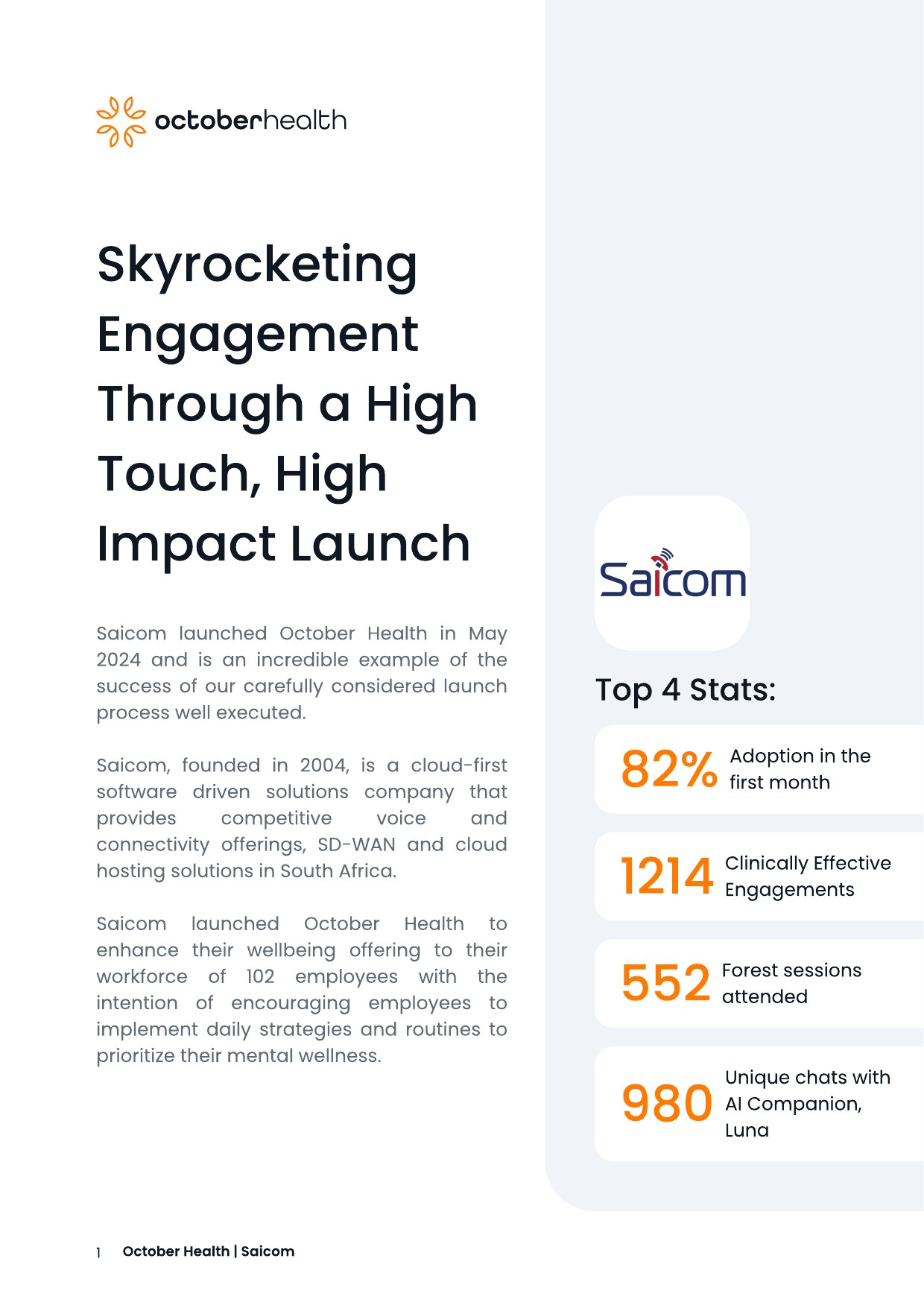
Not a direct one yet, and we won't pretend otherwise. Our proof comes from adjacent regulated, frontline and duty-of-care sectors — higher education, telecommunications and insurance — where the same pressures of shift work, emotional load and retention play out. Milpark reached 80% adoption, Saicom 82%, and IWYZE swung eNPS 24 points.
Yes — that's the design. October runs around 65% utilisation across the whole workforce with sessions, coaching and an AI companion available across shifts, far beyond a phone-line EAP a few percent of people ever use.
October Insights surfaces where strain is building by team and shift before it becomes burnout, and embedded experts help you act on it — so the people carrying the emotional load aren't left without support.
Yes. October measures wellbeing, burnout, eNPS and retention before and after, by team, giving a regulated, duty-of-care organisation documented proof that it's protecting the people delivering care.
A legacy EAP sits at low single-digit utilisation and gives you little usable signal. October runs around 65% utilisation with prioritised insight and embedded experts — clinically effective care delivered confidentially, with outcomes you can stand behind.
Book a walkthrough and see how October would surface the strain across your frontline teams — and the value of getting ahead of it.